Showing posts with label festival. Show all posts

Wednesday, November 16, 2016

Nagoya Matsuri, Avidya: No Lights Inn, and 11/9

On the day of Nagoya Matsuri, I walk the streets around Nagoya Castle with my mentor, Yasuko Senda. Traffic has been redirected due to the festival, so today this iconic Japanese landmark feels more like a sanctuary and less of a major urban attraction. 


(Creative Commons, Wikipedia)

On a typical October afternoon, taxis line-up with eager tourists as young men stroll the grounds cosplaying as Edo era samurais. This theatrical fad has sparked admiration from teenage girls, who often come out in large groups to take photos and interact with the sword wielding thespians. This trend of Edo era recreation is mirrored by the castle itself. The majority of the historic monument was reconstructed after being demolished by American air raids during World War II.


(Creative Commons, Wikipedia)
The attacks didn't just destroy the 17th century castle, but a quarter of Nagoya's structures, thousands of human lives, and countless cultural artifacts, including the dashi and karakuri ningyo puppets that were the hallmark of Nagoya's original matsuri, Toshogu Fetival. 


During the Edo Period, puppets were recognized as a bridge between the human and spiritual world. Bunraku stems from the shinto ritual of ebisu-mawashi, where puppets serve as vehicles to eliminate impurity and grant good fortune. Karakuri ningyo puppets, operated on top of 6 meter dashi, are considered channels to the transcendent. These performative practices wade through darkness to reach the intangible. However, in 1945 the human world rendered these devices spiritually and physically powerless. After World War II, one of Japan's oldest festivals, Toshogu Matsuri, was discontinued and ritual puppetry went quiet for decades.

In Nagoya, the destruction from War World II was paved over by large efficient highways, modern skyscrapers, and pachinko parlors. Compared to Japan’s other major cities, Nagoya feels extremely new and many signals from the past are difficult to discern. It's easy for outsiders to spend weeks in Nagoya without recognizing its trauma from World War II. 


Yasuko Senda was a young girl in Nagoya during the Amerian air raids. There's a part of me that wants to ask about her experiences - but the issue always feels too complicated to broach. Instead, we talk about puppets, and spend the afternoon watching Nagoya's karakuri ningyo performances.


One month later, I am sitting in rehearsal for Niwa Gekidan Penino's original production Avidya: No Lights Inn when I read the results of this year's election.

The play is the creation of psychologist turned theater director Kuro Tanino. On the stage, a blind man, Matsuo, played by Hayato More, nervously makes a cup of a tea for the Inn's newest visitor, a three-foot itinerant puppeteer named Kurata.

"Some say the blind are closer to the mind's eye." Matsuo tells Kurata.

I stare at my phone as anxiety sets in. I grow hot. My heart races.

Kurata lights a cigarette. The actor, Mame Yamada, captures a lifetime of unsettling melancholy with a single puff. The clouds of tobacco rise across Tanino's highly detailed and Kafkaesque set. I think about my mom, who admired Hillary more than any other public figure. For my mother, she was a symbol of self-worth, and the pursuit of a dream in the face of ridicule. She would have looked to Clinton’s victory as a reconciliation with unjust pieces from her own past, and in many ways, I looked towards the election to reconcile some of the grief from my mom’s passing.

It didn't come.

"What will you do when you see it? Your spirit?" Kurata asks Matsuo.

Matsuo is caught off guard. He drops his cup of tea against the table.

"Just see it, I guess."

Often, I look at this fellowship the same way. I imagine there will be answers to plaguing existential grief waiting for me at Ise Shrine, or a farm village theatre in Tokushima. These opportunities bring me to new worlds — I discover new ideas. 
But instead of resolve I once expected to find, I'm met with only more questions, and perhaps that is the only resolution I should expect.

In Avidya: No Lights Inn, Kuro Tanino has created an unsettling world. The suspense digs into deep-rooted feelings of anxiety. The play is pushed inside a magnificent oversized dollhouse, where actors appear in highly-detailed rooms like distressed fish in an aquarium. As I move between my phone and the play, my reality blurs between the two. The show spills from the stage and illuminates the dread that's been lurking this whole time.


            (Photograph by Shinsuke Sugino)


Avidya is a Buddhist concept that translates to “ignorance." It's a refusal to accept the world's impermanence and our fixed state of anguish.

I stare at my phone, my Wifi reception spotty, as I refresh the news feed over and over.

Kurata and Matsuo sit naked in the inn's hot spring. Surrounded by rocks and flickering candles, Kurata whispers to Matsuo, "The spirit you seek, does not exist".

Suddenly, Kuro-san turns to me from the house seats. "Trump?" he asks. "Trump?" he holds up his phone with the United States colored in red swatches.

In order to reach Buddhahood, Matsuo explains, you must surrender your ignorance and face the darkness.

I fear returning for opening night. But I do, and with a couple hundred other people, we confront the dark together.

Avidya: No Lights Inn takes us into a world in-between reality and a dream. Here, transcendence isn't pleasant. And although it’s theatrical, bizarre, and in another language, Avidya holds more truth for me than the last two years of news, history books, or commentary from political pundits combined. 


                                                                               (Photograph by Shinsuke Sugino)


After the performance, a group of American spectators ecstatically compliment Kuro Tanino on his show. At the after-party, festival directors are pleased, the cast is excited, and the drinks are plentiful, but Kuro Tanino looks shaken. As actors joke over shared dishes of spicy tofu and Chinese noodles, he keeps returning to the chair next to mine. "Where does America want to go?" he asks over and over. "I don't understand."

I can't answer. Not because I don't know the language, but because I just don't know.

Kuro Tanino created a show that wrestles with darkness and swims around in a wonderfully dreadful dream, and yet the American election left him clearly troubled. 


But theater never promised answers like our political system. Instead it creates a place to linger in fleeting transience. 
It takes us into the dark, where we'll momentarily relinquish our ignorance, and stumble around, hands out-stretched, fumbling to find each other.


For more information on Kuro Tanino and Niwa Gekidan Penino, please visit: http://niwagekidan.org/english


Tuesday, November 1, 2016

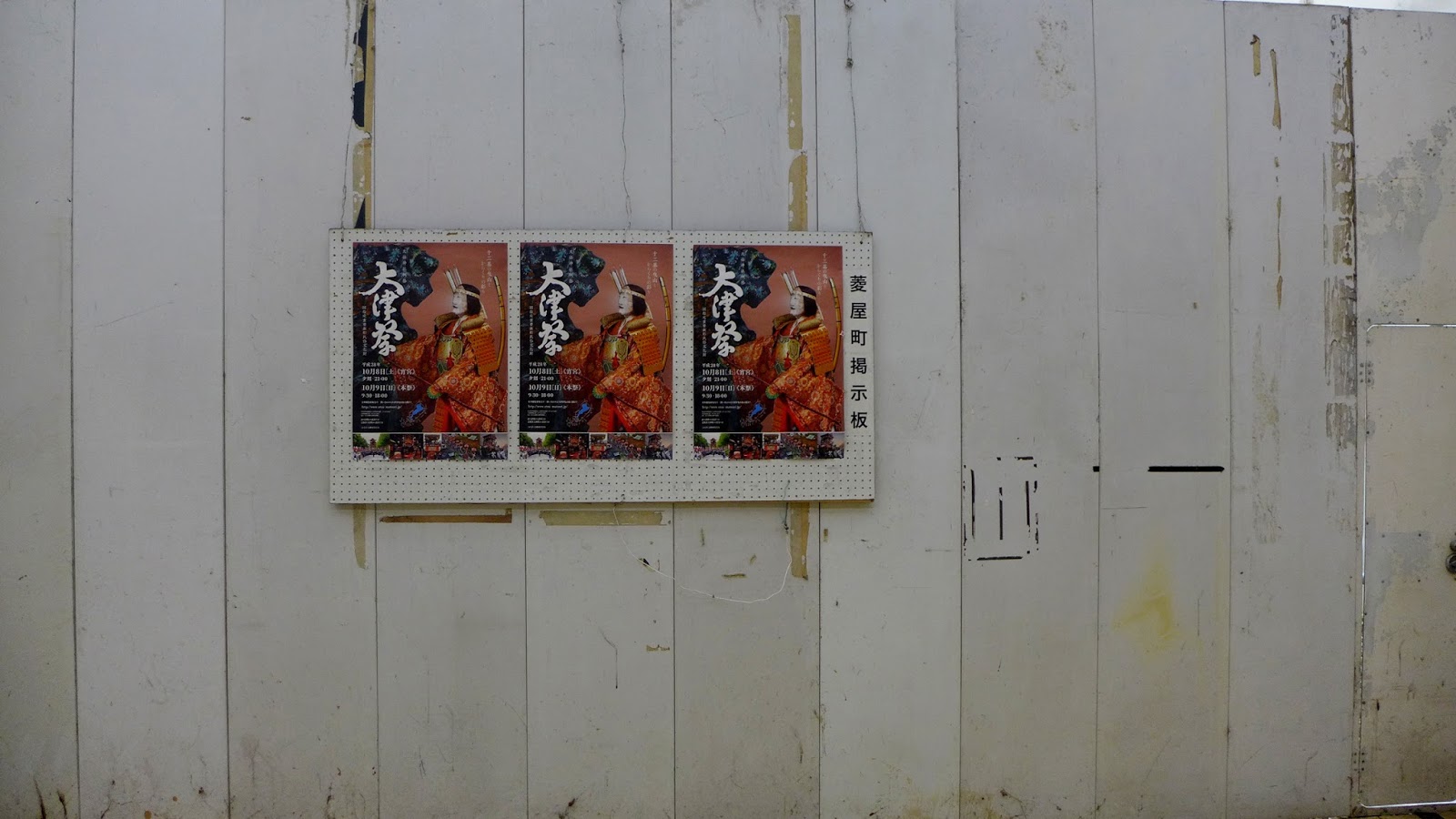
Otsu Matsuri

“So how many puppeteers operate the karakuri ningyo?” I ask Mr. Yamada.

“Karako” he corrects. "Four."

“And the karakuri ningyo’s age?” I ask.

“Karako” he insists.

Karako was the only name these mechanical puppets went by in Toda, and it seemed by Mr. Yamada's insistence that calling them anything else was blasphemous.

It was an easy enough word, karako, but I had to forget what I previously spent hours practicing. Before I arrived in Japan I rehearsed my bow in the shower, trying to bend at a dignified 45 degrees, and repeated the Japanese words for "mechanical doll" over and over. "Ka-rakuri ningyo, kala-kurri ning-yo, ka-da-kuri ning-yo".


At some point I got a handle on the phrase and now when I tell people why I came to Japan I don't have to move my arms like a robot while saying the word for "doll" over and over again. But the more festivals I attend, the more I realize that every matsuri has its own vernacular. Karakuri ningyo only gets me so far.

The terminology is not the only difference. The puppets' mechanics, the performance techniques, and the design of the dashi are just a few of the distinctions you'll come across in each city. There's no place you'll experience these differences more vividly than at Otsu Matsuri. 


According to my mentor Yasuko Senda-san, until the 1980s outsiders were not openly invited to attend Japanese matsuri. While we imagine the "outsider" as a backpacking Westerner, during the Edo period when many of these Matsuri developed, an "outsider" could be anyone who didn't live in the town. It was considered a disservice to the city, the shrine’s deities, and ancestors who participated before to pull influence from other matsuri and homogenize the ritual, language, and performance methods. 


This is one of the many paradoxes I have experienced in Japan. It's a collective society that fosters uniformity, while also maintaining extreme examples of individuality and uniqueness. Japan is known for it's ubiquitous school uniforms and well-dressed salary men, but also for the extraordinarily unique fashions of Harajuku. 


Lucky for me the mechanical puppets in Otsu are called karakuri ningyo, however, instead of dashi, Otsu Matsuri's floats were often called hoko or yama. The hoko look similar to other festival dashi, but they have an additional front wheel and a top tier with wooden benches that criss cross the deck. Instead of playing on the first floor of the float, the ohayashi surround the karakuri ningyo puppets on the uppermost stage. The benches provide space for the musicians to sit, their heads peaking over the edge like a passengers on a riverboat.


During the pre-festival afternoon, the kajikata pull the hoko through Otsu's narrow streets. There's no room for the kajikata to dramatically rotate the floats, but there's still plenty of drama as the men haul the hoko up steep slopes to the musical encouragement from the ohayashi. Sure, there's flat roads and wide streets in Otsu, but at a Japanese matsuri, decisions are rarely made out of convenience.


Traffic lights are rotated out of the way of incoming hoko by teams of police officers clutching neon rope, while spectators are forced to squeeze against walls to let the floats pass. As children hang one-handed from the 5 ton hoko and a dozen musicians cram into the 50 square foot stage, it's clear you won't find phrases like safety hazard, capacity limits, or sight lines in the festival handbook.


Unlike the festivals in Aichi Prefecture where the dashi are stored in enormous towering garages, the hoko are dismantled and reconstructed every year. There's over 300 pieces to these 19th century floats, and it takes at least a week to restore just one. The hoko are kept in well-organized storage rooms where you won't find a single screw or nail. The floats are built through a century old technique of interlocking joints. 


That's right, no nails were used in the making of this hoko.


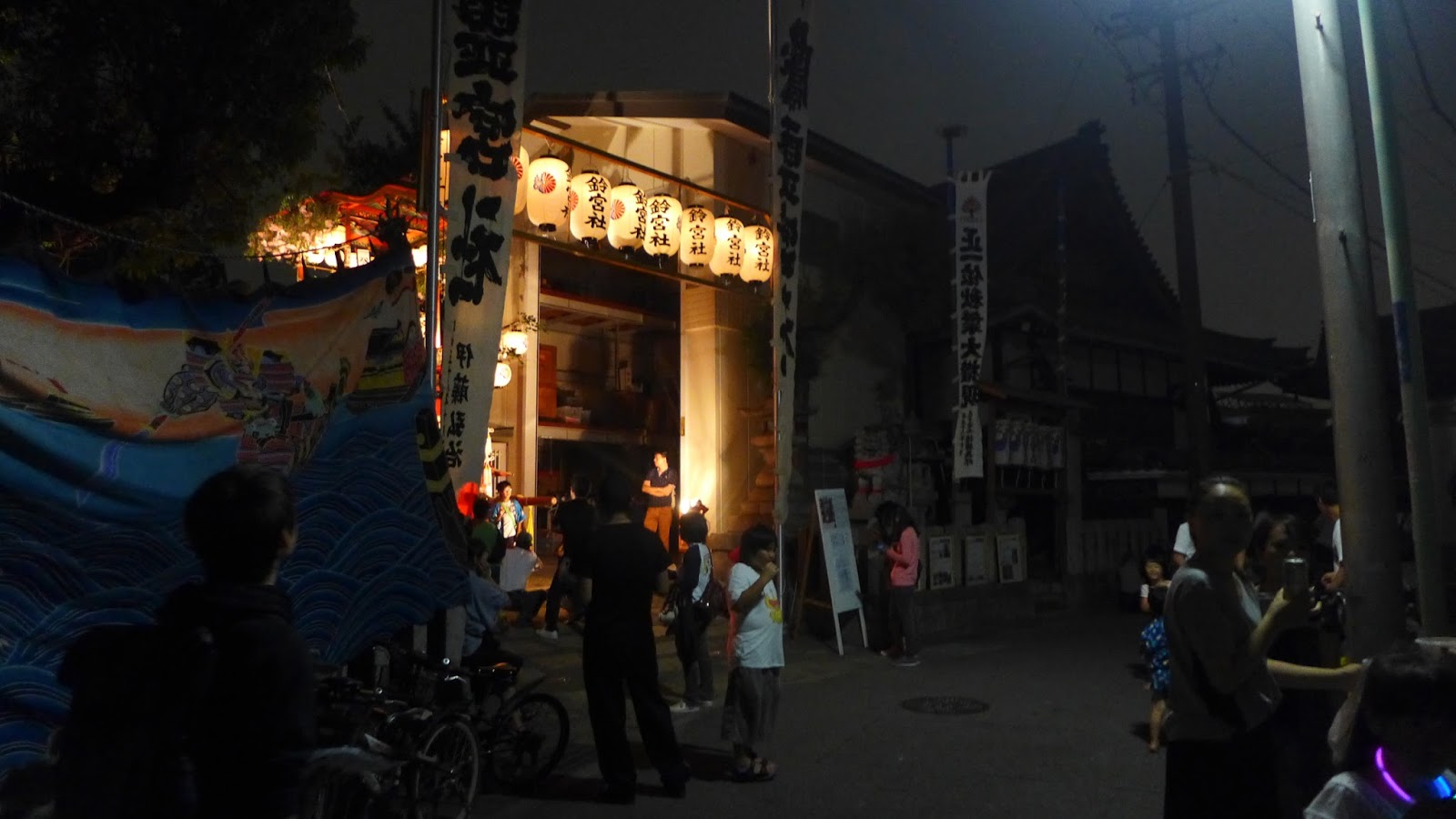
The night before Otsu Matsuri, the hoko line up in the town's narrow alleys and are adorned with hundreds of luminescent Japanese lanterns. 


At each float, visitors are met with cauldrons filled with warm sake, live music, and delicious red bean mochi. 


There's only a few vendors, perhaps because of the lack of space, so the homes facing the festival streets open their garages and offer visitors warm matcha and snacks at makeshift picnic tables. 


The cool breeze, hospitality, and warm tea makes for a cozy evening - but I should enjoy it while it lasts. The sun won't just bring a new day, but about a thousand extra visitors to the tiny streets of Otsu.


At 10:00am, visitors fill the sidewalks near Tenso Shrine. This is the first stop for the karakuri ningyo before they take their annual procession around the city. I feel terrible as I crush an elderly woman with my backpack as the police physically push spectators into ultra-snug clusters to make room for the first hoko.  As the giant float approaches, onlookers race to find the best view. Some have waited hours for this performance and everyone is primed for the show. The ohyashi surround the karakuri ningyo as one young taiko drummer peers over the float and down at my sweaty face with both pity and bewilderment. 


With the release of a loud creaking sigh, the hoko rotates completely away from the audience. Some of the spectators murmur in confusion as the karakuri ningyo face the shrine's entrance disinterested in the crowd's affection. The only audience that counts is the gods, as each puppet show is performed for the unseen deities.


I spend the morning chasing down the hoko with my camera, crawling through crowds, looking for short-cuts around traffic, and trying to get a good view of the karakuri ningyo performances. Traveling through the unfamiliar tiny streets, following music, and trailing behind clusters of people, I'm reminded a bit of Sleep No More, or the one time I sped through Connecticut's Bradley International Airport trying to catch a glimpse of Jennifer Anniston. 

As mentioned previously, the karakuri ningyo at Otsu festival is remarkably different than those in Aichi Precture. Some of the puppets are human-scale with more realistic design. They are often combined with whimsical small-scale puppets that appear from secret compartments.


This use of contrasting scales and fantastical creatures moves the performance in-between reality and the imaginary. The Japanese author Murasaki Shikibu sits at a desk writing The Tale of Genji. Suddenly, her words come to life as miniatures spring up from the bottom of the stage and rotate around her on a mechanical turntable.


Accorrding to Yasuko Senda-san, karakuri ningyo's use of the rotating platform is one of the first examples of the theatrical turntable in Japanese theatrical performance. It was later adopted on a larger scale by Japanese joruri performances.

Besides the difference in scale and aesthetics, the manipulation is Otsu Matsuri is also distinct. For each performance there is only one or two puppeteers who manipulate the puppets from the hoko's middle tier. This area is kept covered by large ornamental embroidery. Instead of operating the puppets directly below the figures, like a conventional rod puppet, the puppeteers use mechanical tracks and strings. As a result, the puppets' movements are more robotic and precise, sort of like a cuckoo clock. These mechanical tracks, or toi, are a trademark of Otsu's karakuri ningyo. 

In one memorable performance there is an external toi that takes the shape of a Japanese tree branch reaching over the hoko and above the audience. A hanging fruit opens to reveal a fairy. The fairy makes his away across the tree branch, and happily dances above the audience. 


In one of my favorite performances, a Japanese flute calls forth a lion. A secret compartment opens on the stage to reveal the adorable mechanical beast. The lion frolics across the toi to the applause of the audience below. 


This lion and fairy performances remind me of the countless colorful characters that appear everywhere imaginable in Japan. Warnings, instructions, and city logos are transformed into big-eyed moments of delight: an endearing amphibian reminds me to avoid putting my hand in-between the elevator's moving doors and an owl dressed like a police officer greets me as I activate a cross-walk signal. 

It's a lot easier to remember to turn off the lights when you leave your apartment when you're prompted by a picture of a deer wearing a kimono. As I watch the Shisa hop across the toi to an adoring crowd, it's clear that Japan's kawaii aesthetic can be traced back to Japanese's rich culture of performance and folklore. 

I want to stick around Otsu to discover the other characters that will unexpectedly emerge from the colorful hoko, but I have a train to catch. Takayama Matsuri starts in just three hours and it's 200 miles away. 


As I slip out of the crowd surrounding the Shisa's float, my vacant spot is quickly filled. I trace my steps back to Otsu Station and pass a couple racing through the back streets, trying to bypass the human congestion to get a good spot for the next performance. The way we race through traffic and nudge through crowds just to gawk up at these characters you'd  think they were celebrities. But they're not. These mechanical actors don't care about our adoration or applause. In fact, I'm certain they'd still be here, with or without us, performing for the gods.


Monday, October 24, 2016

Tsushima Matsuri

It's almost midnight when I arrive back to Nagoya from Toda Matsuri. It's Saturday night, and while groups of young people head out for a night in Naka-Ward, I take the elevator to the eighth floor of my apartment building, eat green tea ice cream and fall asleep without flossing.

At 9:00, I put on my headphones, turn on Fresh Air with Terry Gross, and take the train from Nagoya Station to Tsushima. I keep Google Maps open on my iPhone, but it's impossible to miss the stop. The dozen or so dashi tower above the Meitetsu subway line and can be seen from a mile away.


A chorus line of golden floats greets the arriving visitors to Tsushima in a vast concrete parking lot. Like royalty, they remain fifty yards from the crowd, protected by barricades, cameramen, and police officers. Unlike Toda and Tahara Matsuri, this is the type of well known festival that gets pictures in Lonely Planet guidebooks and shows up on the top of Trip Advisor message boards. There's 13 dashi, each with karakuri ningyo, and an additional fleet of six majestic 18th century floats that ferry enormous taiko drums. Embellished in silver plating and detailed cypress accents, these smaller floats look like miniature trireme ships with the main mast shouldering rows of Japanese lanterns.


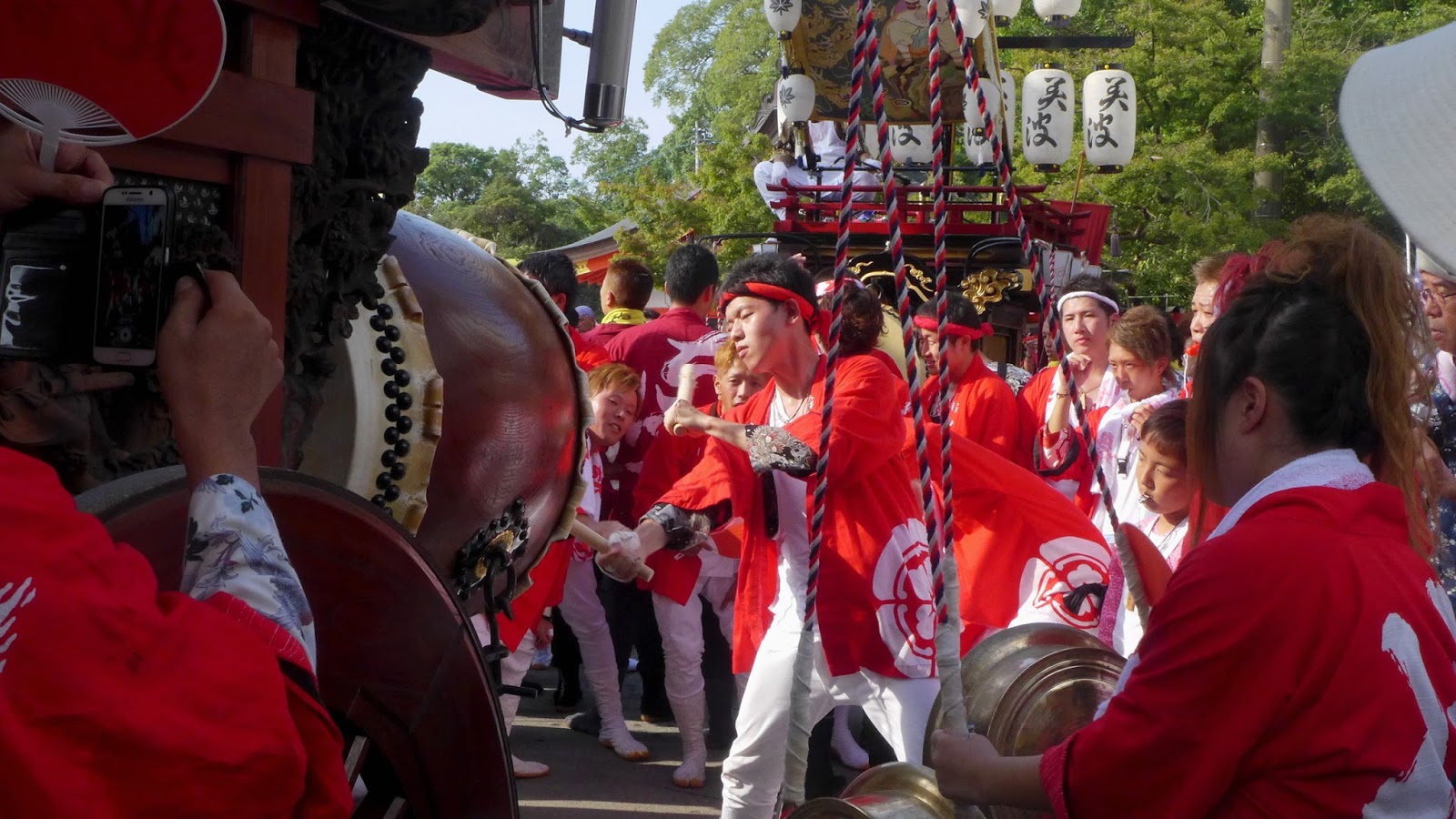
Groups of Japanese twenty-somethings surround the floats in matching matsuri uniforms, trading jokes and greeting their friends with cold beer. They announce the start of the festival with fierce thumps on the taiko drums. But these thumps don't stop - they continue in rapid succession, shaping the rhythm for the next two hours.


As the music picks-up, it becomes more infectious. The men start to jostle each other towards the taiko drum as the girls hammer on Japanese cymbals known as chanchiki. In Yokosuka, the Japanese flutes and shamisen were stars of the festivals. In Tsushima, they're discarded for the thud of the taiko. 

The cries of sports whistles joins the ensemble as the drums hasten. I'm convinced the sounds are about to reach a final coda, but like a musical magic trick, the drums loop into a never-ending crescendo. Men wrap their arms around their neighbor's shoulders and fall over each other in a musical daze. Perhaps the barricades aren't to protect the dashi from the audience, I think, but to protect the audience from the musicians.

As I watch a girl with purple hair extensions drink an enormous bottle of sake, it starts to feel like I'm watching a party from the front lawn. The mood inside is feverish, pulsating, and exciting - out here, beyond the barricades, it's just kinda hot.


Like a sail rising from the mast, the ebony floats unfurl embroidered canopies and cruise down the main street towards Tsushima Shrine. Groups of adolescent flute players gather on the dashi's first tier and strike up their orchestration, as the floats start their journeys towards the other end of the street. But this half-a-mile stroll is no intermission - it's the main event: a two hour celebration filled with twirling dashi and roaring music. The entire street is filled with lines of spectators, as the 5 ton dashi are rotated 360 degrees over and over in looping madness.


At one intersection there's a dashi turning competition, known as a donden, where the floats are spun six, eight, then ten times in a row.


The men spinning these ornamental mammoths never rest. I see one grab hold of the side in an exhausted stupor, while another lets out a scream as though possessed. 


One man stands on top of a float and tosses what looks like brightly colored mochi into the crowd. People are going crazy, waving their arms and shouting for his attention. This must be some delicious mochi. One is thrown my way as an elderly woman knocks me out of the way, effortlessly seizing it between her hands. It's not mochi - but a bright yellow towel. Oh dear, I exclaim, as I have a disturbing flashback to a Pittsburgh Steelers game.

At the gates of Tsushima shrine, the taiko drums and chanchiki have reached a new stage of intensity. I watch as a laughing teenage boy steps forward to seize a bachi and take the helm of a taiko drum. His face transforms into stony-faced attention as he skillfully pounds away and feeds the hungry participants.

By 16:00, I'm starting to feel a bit weary, but the musicians and kajikata aren't showing signs of slowing.  A man hangs from the float, clanging a chanchiki close to my hear, as I try to spot the closest bathroom. It's clear, Tsushima Matsuri is way more punk rock than tourist attraction.

The karakuri ningyo performances will take place inside of Tsushima Jinju. The shrine's main tenant is the deity of pestilence and blessings, Gozutenno; however, it also houses over 100 smaller deities throughout the sanctuary. The bright red torii provides a breathtaking backdrop, as each dashi moves center-shrine one-at-a-time to offer its show to the jinju's spiritual dwellers. Similar to the set-up at the train station, the audience watches the karakuri ningyo from about fifty yards away.


Each dashi has a puppet that stands on the lower tier and waves a shinto gohei prior to the performance. The floats have remarkable details. The roof on one dashi ascends from a trap door, magically revealing the top tier's karakuri ningyo .

In one show, a woman dances across the stage as her face transforms into a orangutan, back into a woman, and then a orangutan again for good measure.


One of my favorite performances was created by Tamaya Shobei V in 1887. Two puppets stand upstage as another moves center and transforms into a boat. Like a Toy Theater show, two-dimensional waves extend from the bottom of the stage and rock back and forth as the boat's miniature sail flaps in the wind.


In one karakuri ningyo performance, an entertainer cheers up a despondent emperor with... a karakuri ningyo performance. 


In the final karakuri ningyo act, a shinto priestess, or miko, approaches a cauldron that sits on the end of an overhanging eight foot rail. This is one of the first dashi I've seen with an external track, or toi, that lets the puppets move outside of the float. It's incredibly effective, as the miko waves a palm branch towards the audience in a cleansing ritual. At the end of her ceremony, paper flies out of the cauldron in a magical burst. But as I watch the confetti fall to the empty ground below, there's a part of me that wants to be closer.


During the thirteen performances, my thoughts drift to American politics, ice cream, and health insurance. I watch Tsushima's calligrapher puppet and compare it to the one last night in Toda (not nearly as impressive). I start to shape a to-do list for the upcoming week when I realize my problem - the physical distance between me and the floats have made it easier to take up residence in my own head. I remind myself to be present. Most of the karakuri ningyo are marvelous, and I feel lucky to have attended. But it's worth noting its the first time I've felt like spectator instead of a participant. 


What I usually love about karakuri ningyo and Japan's matsuri culture is the blurring between audience and performance. The theaters physically move through the crowds and travel through narrow streets. They're indifferent to where you stand, and don't mind if you gawk a few feet away at their ornamental beauty. As the oyahashi and kajikata spill past, you're impelled to follow behind.

It's never felt like these towns are hosting the matsuri; the matsuri hosts the city. This ambivalence towards an audience and simultaneous invitation to join-in gives the viewer no choice but to participate. When you're standing inside of a crowd, chasing after a roaming theater, watching mechanical puppets perform magic tricks while the person next to you gasps with delight, it's easy to forget about the stuff inside your head. You're invited to the party.


Monday, October 17, 2016

Toda Matsuri

A group of elementary school students endlessly air-drum beneath the festival's dashi. They don't want to miss a note during tonight's performance. At Toda Matsuri, most of the musicians are children who have spent the last month of music class in preparation. 


The audience is made-up of parents, proudly poised with digital cameras, and younger siblings who run freely through the shrine while grasping cotton candy. Sure - it's not a large crowd, but there's something so pleasant and comfortable about the small-town atmosphere in Toda that I catch myself singing The Gilmore Girls' theme song aloud to no one in particular. 

I spend the afternoon at Hachiman shrine with a festival organizer, Mr. Yamada. Even at seventy three, Mr. Yamada climbs through the three-floor dashi with ease.


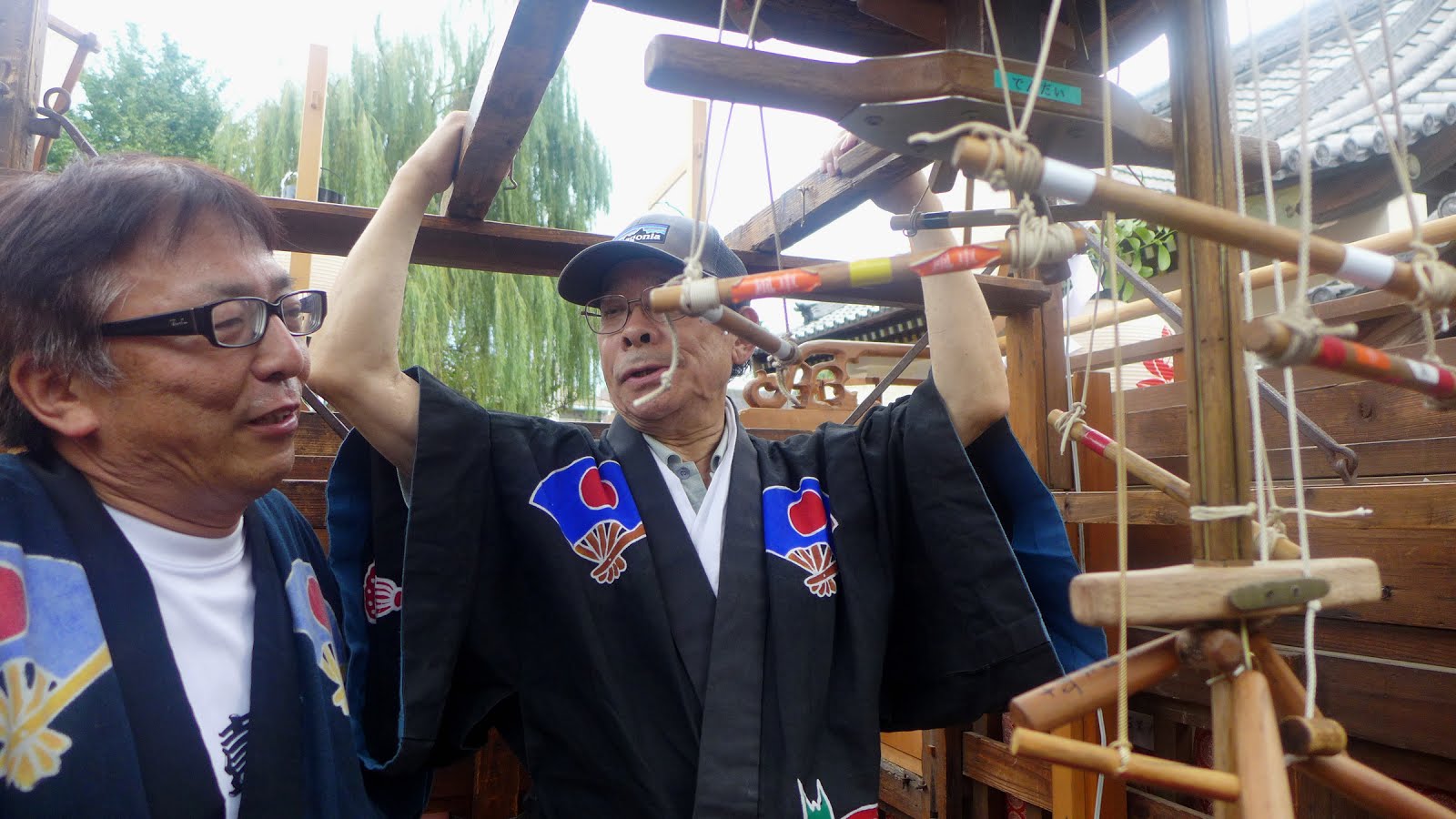
He is excited to speak English, share the shrine's history, and show off his fresh surgical scar from kidney surgery. Asahi beer cans, plastic containers of curry, and cigarettes line the edge of the 18th century dashi, as I climb on board and head to the second floor. The puppeteers are easy-going, but the karakuri ningyo is anything but simple. The puppet’s controls are a mix of strings, handle bars, and the sashigane technique I observed in Yokosuka.


To make things manageable, the puppeteers place brightly colored labels on each handle, and wear battery-operated headlamps during the performance.

Mr. Yamada explains that the puppets suspended above our heads are milling rice. The two robotic farmers rotate the mill with hand cranks, while a miniature acrobat stands on top. After a full rotation, a stage extends from the center of the mill and the puppet leaps into an impressive hand-stand. To Mr. Yamada, this performance captures the essence of Toda. "Rice Milling is Toda's main manufacturing," he says, staring upwards at the wooden puppet. 


A 24-hour automat for uncooked white rice sits outside the shrine and one the most popular fair food this evening is dango (sweet rice dumplings). Rice is Toda's livelihood, and these three mechanical dolls give thanks to the gods who have granted it.


Toda's dashi is not as ornate as those in Yokosuka and Tahara, but they are some of of the oldest I've seen, dating back to 1702. A school teacher announces the performance on a portable karaoke machine, as the students gather into a shapeless circle, shyly hiding from the gaze of their families' cameras. Two grandfathers sit on the edge of the chozuya, or shrine fountain, smoking cigarettes and watching the puppeteer make final adjustments to the karakuri ningyo.


Despite the casualness of the festival, the performance is excellent. The manipulation is smooth and well-rehearsed. And even though the ohayashi is a group of elementary and middle school students, their music reflects the puppets' movements well and creates a unified spectacle.


The kids don't want the show to end. As the audience applauds, they gather around the float with their instruments and continue to play. The puppets join in, waving their arms, milling rice, and nodding their heads to the music below.

My guide this evening is a first year college student named Daiki. We search for the next karakuri ningyo performance at Tenjisha shrine as he tells me about his first semester in dental school. We walk through Toda's dark and narrow alleys with only the light from Google Maps and a few flickering Japanese lanterns. It's one of the first chilly nights of autumn, and traveling the streets, moving from shrine to shrine, it starts to feel a bit like Halloween."Have you seen Gilmore Girls?" I ask Daiki. He never heard of it- but he is a big Bruno Mars fan.  


We catch the glow of a dashi in the distance, give-up on Google Maps, and follow it.

Two rows of children sit behind kotsuzumi drums. The music teacher provides some last minute instructions as a dozen young boys line-up in front of the hanging taiko.


The drums pulse as the karakuri ningyo climbs across a set of monkey bars and hangs upside down from his knees. Like a magician rolling up his sleeves, the last bar rotates outward with the swinging puppet hovering above the ground, revealing the absence of strings or rods. The karakuri ningyo returns to his original position as the boys make their final blows on the large taiko drum.


At Zuyumia shrine, Daiki introduces me to dango, a sweet rice dumpling that is lightly seared over flames and covered in a Japanese molasses.


It's only 100 yen and the line is short, so I go back for seconds, promising Daiki I will floss after I get back to my apartment.


As the night falls, teenagers come out to enjoy the festival food, watch the performances, and snap photos. But, without the presence of tv crews and tourists, the festival never gets overwhelming. No one is worried about applying enough sunscreen, a crowded train ride home, or squeezing through people to get a better spot for the next performance. With the fall breeze and natural small-town coziness, there's something about Toda Matsuri that feels unexpectedly nostalgic.

But the festival never gets overwhelming. No one is worried about applying enough sunscreen, a crowded train ride home, or squeezing through people to get a better spot for the next performance. With the fall breeze and natural small-town coziness, there's something about Toda Matsuri that feels unexpectedly nostalgic.


A Chinese calligrapher stands at the top of the dashi at Zuyumia Shrine. Not an actual Chinese calligrapher, but a puppet Chinese calligrapher wearing a grin that suggests he knows exactly how impressed you're about to be.


He removes a pen and starts to write on a suspended piece of translucent paper. The audience can see the ink soak through the paper as lines take shape. If you watch carefully, you can even catch the subtle movement of the puppet's head following the pen's tip.

After the final stroke, the paper is revealed to the audience from the front. I'm not sure what it reads, but the penmanship is flawless. I have to remind myself that it was written by a puppet operated by a 17th century method of strings and wooden rods. 


The crowd of teenagers, children, and parents applaud as the puppeteer emerges. He wears a grin not unlike the puppet, as he removes the paper and holds it above his head.


The audience cheers as he tosses the paper into the air. It floats to a young woman, hands outstretched. She shows her friends, smiling contagiously, and then passes it to a young boy by her side.


"What did it say?" I ask Daiki.

"Akizora," he replies.

"What does that mean?"

"Autumn sky."