Showing posts with label aichi prefecture. Show all posts

Tuesday, July 11, 2017

Chiryu Karakuri Ningyo Company and an Action-Packed Marvel


Hundreds of strings stretch across the puppet stage, criss-crossing over wooden beams, in and out of eye hooks, and through the anticipatory fingers of the puppeteers. There are fifteen members of Chiryu Karakuri Ningyo Company, ten of which are crammed inside the stage surrounded by puppets, sashigane, and scripts marked with hand-inked illustrations. During their bi-annual performances, the troupe usually performs on the top of an 18 foot festival float; however, for this week’s rehearsals they use the portable stage, a 100 square foot wooden frame that fills the entirety of Chiryu City's cozy community center.


As I move from one side of the room to the other, I push my back against the wall and delicately slide, careful not to disturb the concentration of the performers.  The team of puppeteers are like a crew of rowers, pulling strings, skillfully twisting sashigane, and quick-changing puppet costumes in harmonious collaboration.  

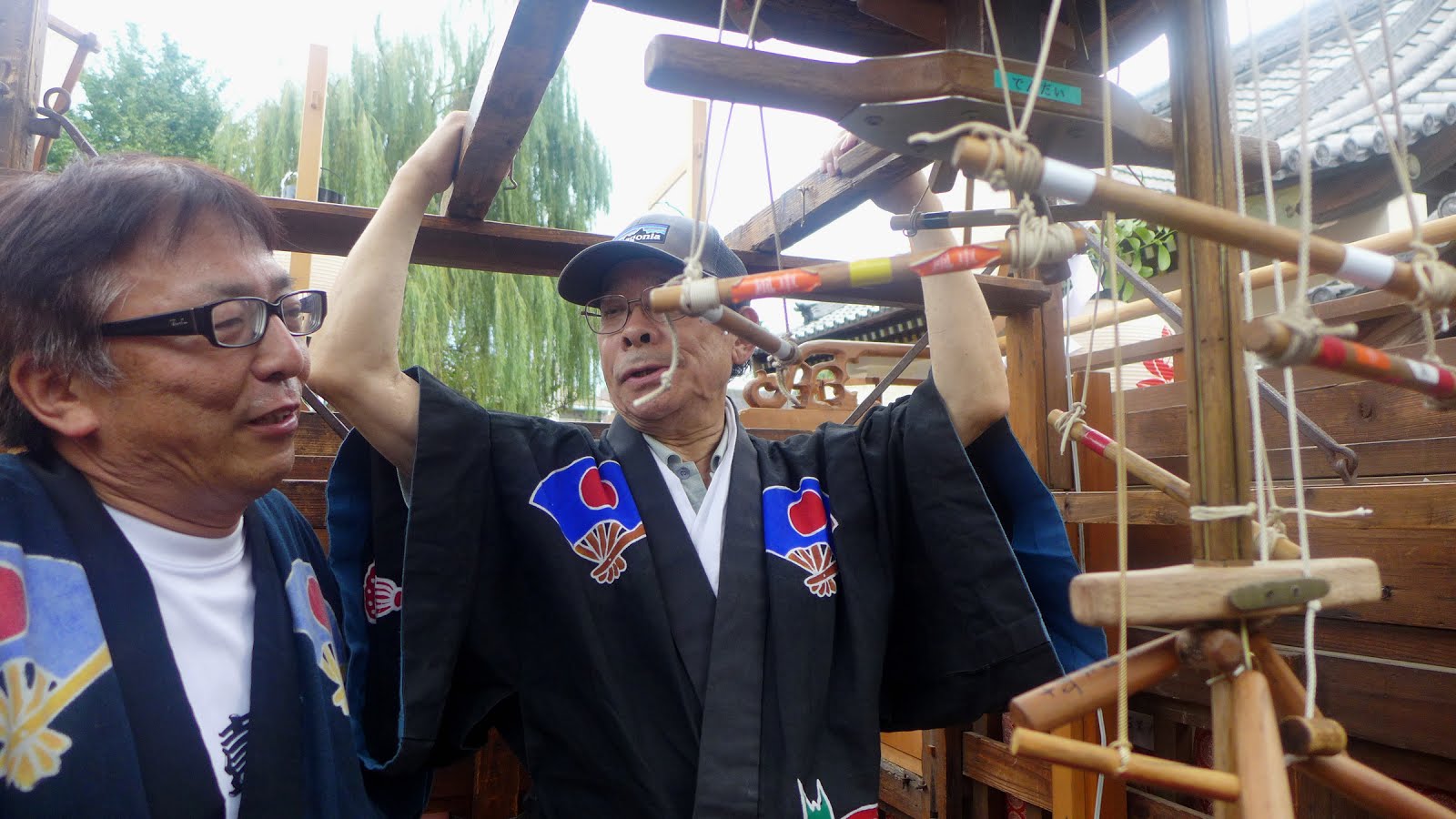
Two long wooden beams, the toi, organize the numerous strings, passing each thread through carefully marked holes. These are the same toi used on the top of the dashi and, along with the puppets, are invaluable components. After every rehearsal the puppeteers wax the internal strings with resin and then carefully pack the tracks for safekeeping.

Although it's considered an amateur troupe, Chiryu Karakuri Company is one of the most skilled and elaborate groups I’ve come across during my fellowship. In 1992, they represented Japan at UNIMA’s World Conference in Slovenia and have performed internationally in Italy and Australia. Led by my mentor and teacher Yasuko Senda, this September they will make their French debut at Festival Mondial Des Theatre de Marionnettes in Charleville-Méziéres. Like other karakuri ningyo companies, such as in Takayama's Hoteitai troupe, the group only performs one program, The Battle of Ichi-no-Tani. In the world of Japanese mechanical puppet theatre, the show is an action-packed blockbuster. The 15 minute spectacle is filled with dramatic Edo era ingenuity: puppets skillfully shooting bow and arrows, a samurai showdown, and a gleeful warrior twirling a skewered corpse on the end of a spear.


With the unique assistance of a tayu, which I have not seen in any other karakuri ningyo performances, it’s one of the few companies that weaves their audience through a narrative, recreating a legend from the 12th century’s Genji and Heike feud. Like joruri ningyo, karakuri ningyo began as a shinto ritual performed during festivals to offer gratitude to the gods. However, during the Edo era, as ningyo joruri diversified into itinerant performance, comical entertainment, and historical dramatization, karakuri ningyo held fast to its shinto roots. Today, the majority of performances are brimming with the same rhythmic movements, symbolic transformations, and spectacular gestures of the original ritualistic shows. The Battle of Ichi-no-Tani, with a cast of historical characters, live narration, and a fifteen minute runtime, offers something totally different.

The development of karakuri ningyo into historical drama might be due to another unique feature of Chiryu's company. On the first floor of the dashi, a platform extends specifically for ningyo joruri performances. These shows, which occur before the robotic puppets take the stage, date back to the matsuri’s Edo era origins.


It’s likely that this integration with local joururi ningyo troupes influenced the karakuri company to try its hand at historical storytelling and incorporate the bunraku trifecta: tayu, shamisen, and puppeteer. The dashi reflects this synthesis, with a center tier that is dedicated to the narrator and shamisen player, forming a towering theater with three different stages.


While Chiryu Karakuri Ningyo Company usually only performs every other spring, this year they are busier than ever as I follow them to indoor shows at cultural centers, rehearsals for Charleville-Méziéres, and celebratory events that mark their introduction into UNESCO's Cultural Heritage list. It’s an exciting and fruitful time for a puppet company that almost didn’t survive the 20th century. 


Like most puppet troupes in Japan during World War II, Chiryu’s karakuri ningyo performances completely ceased. It took some companies decades to recuperate after wartime due to the destruction of puppets, lack of national pride, and economic strain. Luckily, Chiryu City found the funds and spirit to rejuvenate the dormant tradition. In 1950 The Chiryu Karakuri Ningyo Company was founded by Mr. Shinji Sakata. Today, the company is directed by his son, Morohiko Sakata, and has almost twenty members. It’s a diverse group of insurance salesmen, farmers, students, an architect, and a few city officials. 


Some of the men have been performing together for almost 30 years, but there are still plenty of new members. In order to survive, there has to be. While the masters of other Japanese traditional arts, such as noh, bunraku, and kabuki, are often in their 70s and 80s, karakuri ningyo takes a lot of unexpected endurance and dexterity. 

In order to reach the top tier of a dashi, you must pull yourself upwards through tiny compartments, your hands gripping the floor as puppeteers navigate around you. Once at the peak, you balance in-between wooden cross beams as you stretch your neck upward to manipulate the puppets, trying to avoid the glare of the sun.  


My original expectation was karakuri ningyo would be similar to handling a marionette, requiring a sense of elegance and specificity. While the puppet’s movements can be crisp and expressive, there’s nothing graceful about the manipulation. As I jostle rods and tug at string, it feels like operating heavy machinery. I often struggle to garner enough strength. The puppets, fabricated from Hinoki wood, are heavy and difficult to command. Not to mention they’re filled with interior mechanisms, additional costumes, and hidden characters.


For example, the onerous puppet of Okabe includes a collapsed miniature Shinto shrine and an additional puppet head. He also wields a spear that swings another karakuri ningyo around on its end. To manipulate Okabe, it doesn't just take practice, but serious muscle-power. 


Now, I see karakuri ningyo's manipulation more similar to the powerful puppet machines from Walking with Dinosaurs than marionettes or rod puppets. I’m awed by the troupe’s greatest trick of all - they make it look easy. 

After rehearsals, as the group gathers around the small television set with beer and kameda crisps to watch footage of past performances, the youngest members hang by the stage. 


They’re trying to get a grasp on the puppet, Kojiro, a boy warrior who must draw a bow and strike his arrow at the center of a target. There’s no illusion. The puppet must really pull-off the coup. Manipulating only Kojiro’s arms and hands through a series of strings and rods, it’s even more difficult than shooting the real thing. 


The young men practice over and over, most of the time unable to get Kojiro to successfully string the bow. One of the old-timers approaches, beer in hand, and takes a stab at it. He tugs on the strings. Kojiro draws. Bullseye. 


Wednesday, May 10, 2017

The Towering Matsuri of Inuyama & Ichinomiya

On April 1st, Inuyama Matsuri marks the start of Japan's spring festival season. Over the course of a few months, hundreds of floats will emerge from their winter hibernation and travel across the small towns of Aichi Prefecture bringing music, excitement, and puppet shows.

Often known as Aichi's "Little Kyoto,” Inuyama is lined with preserved Edo era homes, traditional Japanese inns, tea houses, and museums. The small but popular destination welcomes visitors with Japan's oldest castle, which towers over Haritsuna Shrine, home base for Inuyama's spring festival. With its enormous parade of thirteen ornamental dashi, large crowds of excited visitors, and neighborhoods brimming with culture, Inuyama is the perfect place to fall back into Japan's festival season.

On the first day of the celebration, Inuyama's dashi, or yama, gather in front of Haritsuna Shrine. The thirteen floats, each adorned with karakuri ningyo, tower above thousands of eager spectators. These are some of the tallest dashi in the Japan, measuring about 7 meters high. However, they are more slender than their cousins, and, despite their height, weigh about the same. Instead of ornate wooden carvings, the dashi are constructed from narrow beams and adorned in local textiles. Also, To help manage the float's weight, the karakuri ningyo puppets are a bit smaller.


Inuyama Matsuri is home to one of Aichi's most unique floats, a stunning 6 meter boat that travels through the narrow streets performing the story of Urashima, an old man who spends four hundred years underneath the Pacific. Typically a dashi's decorations, carvings, and embroidery won't offer too many clues into the karakuri ningyo they shelter. However, this stunning gold-trimmed vessel creates a unified vision of Urashima's famous nautical tale.


Urashima is not the only celebrated personality at Inuyama Matsuri. While children always play an important role in Japanese festivals, from pulling floats to playing music, the kids in Inuyama are adorned like living idols. The leader of the annual festival, or chigo, is selected each year from local primary school students. This six year old is draped in silks and a crown as he leads the annual procession.


Other children are dressed in beautiful outfits accessorized with decorative swans.


Like the blossoming sakura that attracts millions of tourists to Japan from across the globe, children represent Spring's sense of purity, rebirth, and future prosperity.

However, this has not been a good year for cherry blossoms. While April 1st in Inuyama is usually marked by a vibrant backdrop of blooming flowers, an unusual shift in weather has brought a spring season lacking the renowned colorful flourishes. As the afternoon parade of children lead the dashi underneath the naked trees, my mentor and friend Yasuko Senda can't help but mention the number of kids participating seems to shrink each year.


For locals, the future of these festival traditions always feels precarious. During the opening ceremonies, Inuyama's mayor mentions another event happening simultaneously 30km away - the grand opening of Japan's first Legoland. Sure, it will contribute to the economic development and growth of tourism to Aichi Prefecture, but the mayor reminds the crowd that it's got nothing on his hometown's 383 year old festival.


Compared to performances of Bunraku and Noh, where the majority of audience members are elderly enthusiasts in their 70s and 80s, I feel like Japan's festivals are far from drifting into obscurity. I mean, I just had to scramble through a crowd 3,000 people to watch a puppet show. But the residents in small town Japan are more aware of the country's population decline and impact of locals migrating to urban centers. It's inescapable, no matter how busy the festivals get. The children, with swans rising from their backs and head pieces tangled into blinking LEDs, aren't just symbols, but physical treasures of hope and endurance. 


Inuyama Matsuri continues for two days, marked by a stunning night parade and another performance of the thirteen karakuri ningyo.


The shows on the second day are performed at the shrine. Each dashi is pushed towards the torii gate by a team of young men. 


Unlike other floats, the massive wheels allow men to gather underneath the dashi to push and pull the towering vehicles throughout the city.


The floats are are filled with the local children, who look down at the crowds with curiosity, as the puppets perform for the gods.


In the neighboring city of Ichinomiya, the small town hosts their own festival two weeks later. Given their close proximity, the two matsuri share a lot of similarities, particularly the slender and towering dashi. However, Ichinomiya's floats are more modest. Instead of expensive fabrics and ornate decorations, the dashi are decorated in white papers that symbolize donations received from community members.


Inuyama's city government allocates a large budget to preserve and promote the annual festival. However, Ichinomiya lacks government support. Instead, the festival relies on the local shrine, Iwato Jinja, to organize fundraising efforts. While the festival might feel a bit more unorganized, lacking the Master of Ceremonies and VIP tents for special guests, the event is filled with ritual, including the offering of seven well-dressed horses to the shrine's god before they are paraded through the town's streets.


While the dashi may not have the same ornamental flare or financial support as Inuyama, the karakuri ningyo in Ichinomiya are well-rehearsed and exciting. It's some of the best performances I've seen so far during the spring season.


While watching the mechanical puppets trapeze across the towering stage, it corroborates my new adage, "You can't judge a puppet by it's dashi."


Monday, October 24, 2016

Tsushima Matsuri

It's almost midnight when I arrive back to Nagoya from Toda Matsuri. It's Saturday night, and while groups of young people head out for a night in Naka-Ward, I take the elevator to the eighth floor of my apartment building, eat green tea ice cream and fall asleep without flossing.

At 9:00, I put on my headphones, turn on Fresh Air with Terry Gross, and take the train from Nagoya Station to Tsushima. I keep Google Maps open on my iPhone, but it's impossible to miss the stop. The dozen or so dashi tower above the Meitetsu subway line and can be seen from a mile away.


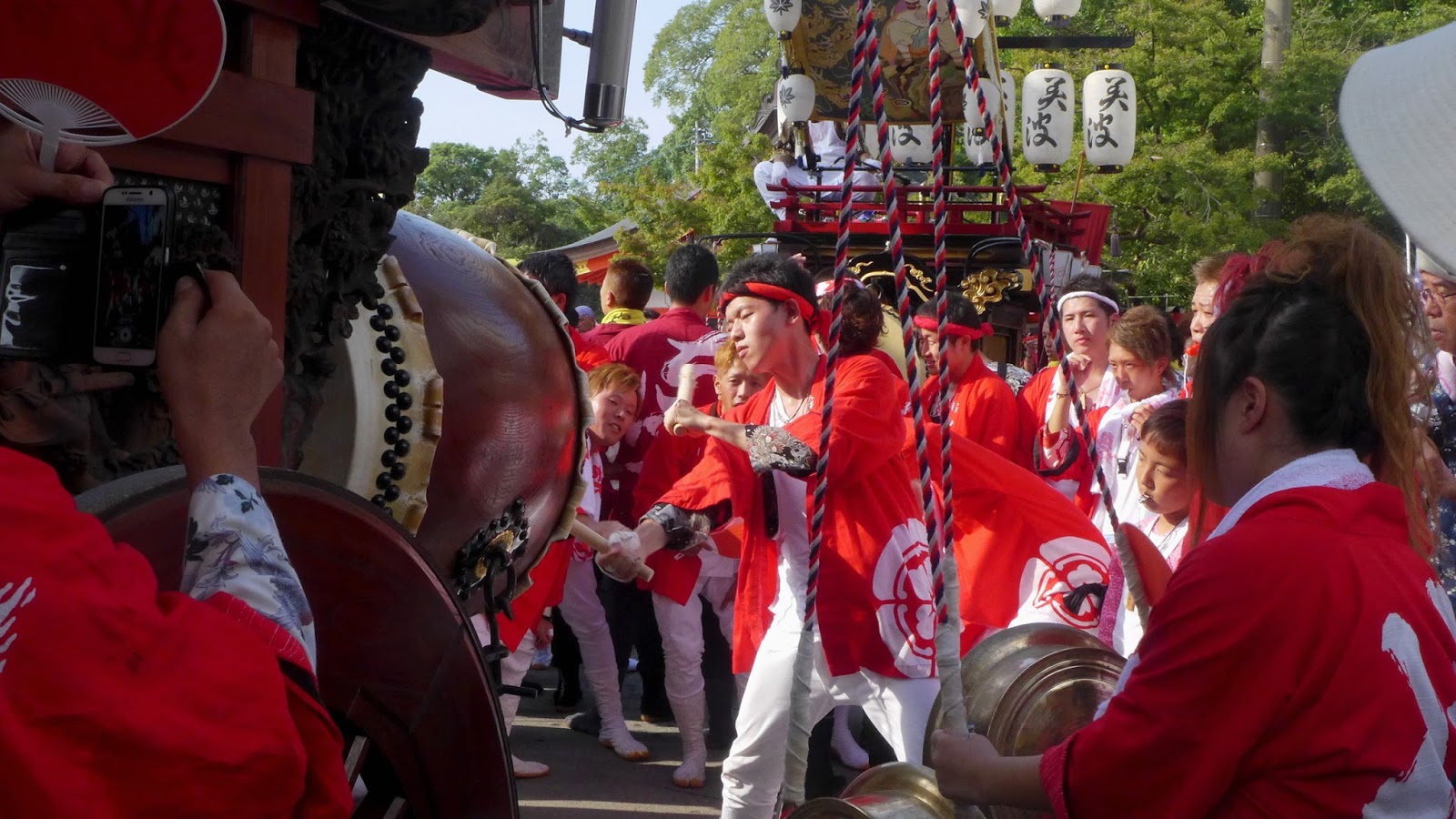
A chorus line of golden floats greets the arriving visitors to Tsushima in a vast concrete parking lot. Like royalty, they remain fifty yards from the crowd, protected by barricades, cameramen, and police officers. Unlike Toda and Tahara Matsuri, this is the type of well known festival that gets pictures in Lonely Planet guidebooks and shows up on the top of Trip Advisor message boards. There's 13 dashi, each with karakuri ningyo, and an additional fleet of six majestic 18th century floats that ferry enormous taiko drums. Embellished in silver plating and detailed cypress accents, these smaller floats look like miniature trireme ships with the main mast shouldering rows of Japanese lanterns.


Groups of Japanese twenty-somethings surround the floats in matching matsuri uniforms, trading jokes and greeting their friends with cold beer. They announce the start of the festival with fierce thumps on the taiko drums. But these thumps don't stop - they continue in rapid succession, shaping the rhythm for the next two hours.


As the music picks-up, it becomes more infectious. The men start to jostle each other towards the taiko drum as the girls hammer on Japanese cymbals known as chanchiki. In Yokosuka, the Japanese flutes and shamisen were stars of the festivals. In Tsushima, they're discarded for the thud of the taiko. 

The cries of sports whistles joins the ensemble as the drums hasten. I'm convinced the sounds are about to reach a final coda, but like a musical magic trick, the drums loop into a never-ending crescendo. Men wrap their arms around their neighbor's shoulders and fall over each other in a musical daze. Perhaps the barricades aren't to protect the dashi from the audience, I think, but to protect the audience from the musicians.

As I watch a girl with purple hair extensions drink an enormous bottle of sake, it starts to feel like I'm watching a party from the front lawn. The mood inside is feverish, pulsating, and exciting - out here, beyond the barricades, it's just kinda hot.


Like a sail rising from the mast, the ebony floats unfurl embroidered canopies and cruise down the main street towards Tsushima Shrine. Groups of adolescent flute players gather on the dashi's first tier and strike up their orchestration, as the floats start their journeys towards the other end of the street. But this half-a-mile stroll is no intermission - it's the main event: a two hour celebration filled with twirling dashi and roaring music. The entire street is filled with lines of spectators, as the 5 ton dashi are rotated 360 degrees over and over in looping madness.


At one intersection there's a dashi turning competition, known as a donden, where the floats are spun six, eight, then ten times in a row.


The men spinning these ornamental mammoths never rest. I see one grab hold of the side in an exhausted stupor, while another lets out a scream as though possessed. 


One man stands on top of a float and tosses what looks like brightly colored mochi into the crowd. People are going crazy, waving their arms and shouting for his attention. This must be some delicious mochi. One is thrown my way as an elderly woman knocks me out of the way, effortlessly seizing it between her hands. It's not mochi - but a bright yellow towel. Oh dear, I exclaim, as I have a disturbing flashback to a Pittsburgh Steelers game.

At the gates of Tsushima shrine, the taiko drums and chanchiki have reached a new stage of intensity. I watch as a laughing teenage boy steps forward to seize a bachi and take the helm of a taiko drum. His face transforms into stony-faced attention as he skillfully pounds away and feeds the hungry participants.

By 16:00, I'm starting to feel a bit weary, but the musicians and kajikata aren't showing signs of slowing.  A man hangs from the float, clanging a chanchiki close to my hear, as I try to spot the closest bathroom. It's clear, Tsushima Matsuri is way more punk rock than tourist attraction.

The karakuri ningyo performances will take place inside of Tsushima Jinju. The shrine's main tenant is the deity of pestilence and blessings, Gozutenno; however, it also houses over 100 smaller deities throughout the sanctuary. The bright red torii provides a breathtaking backdrop, as each dashi moves center-shrine one-at-a-time to offer its show to the jinju's spiritual dwellers. Similar to the set-up at the train station, the audience watches the karakuri ningyo from about fifty yards away.


Each dashi has a puppet that stands on the lower tier and waves a shinto gohei prior to the performance. The floats have remarkable details. The roof on one dashi ascends from a trap door, magically revealing the top tier's karakuri ningyo .

In one show, a woman dances across the stage as her face transforms into a orangutan, back into a woman, and then a orangutan again for good measure.


One of my favorite performances was created by Tamaya Shobei V in 1887. Two puppets stand upstage as another moves center and transforms into a boat. Like a Toy Theater show, two-dimensional waves extend from the bottom of the stage and rock back and forth as the boat's miniature sail flaps in the wind.


In one karakuri ningyo performance, an entertainer cheers up a despondent emperor with... a karakuri ningyo performance. 


In the final karakuri ningyo act, a shinto priestess, or miko, approaches a cauldron that sits on the end of an overhanging eight foot rail. This is one of the first dashi I've seen with an external track, or toi, that lets the puppets move outside of the float. It's incredibly effective, as the miko waves a palm branch towards the audience in a cleansing ritual. At the end of her ceremony, paper flies out of the cauldron in a magical burst. But as I watch the confetti fall to the empty ground below, there's a part of me that wants to be closer.


During the thirteen performances, my thoughts drift to American politics, ice cream, and health insurance. I watch Tsushima's calligrapher puppet and compare it to the one last night in Toda (not nearly as impressive). I start to shape a to-do list for the upcoming week when I realize my problem - the physical distance between me and the floats have made it easier to take up residence in my own head. I remind myself to be present. Most of the karakuri ningyo are marvelous, and I feel lucky to have attended. But it's worth noting its the first time I've felt like spectator instead of a participant. 


What I usually love about karakuri ningyo and Japan's matsuri culture is the blurring between audience and performance. The theaters physically move through the crowds and travel through narrow streets. They're indifferent to where you stand, and don't mind if you gawk a few feet away at their ornamental beauty. As the oyahashi and kajikata spill past, you're impelled to follow behind.

It's never felt like these towns are hosting the matsuri; the matsuri hosts the city. This ambivalence towards an audience and simultaneous invitation to join-in gives the viewer no choice but to participate. When you're standing inside of a crowd, chasing after a roaming theater, watching mechanical puppets perform magic tricks while the person next to you gasps with delight, it's easy to forget about the stuff inside your head. You're invited to the party.


Monday, October 17, 2016

Toda Matsuri

A group of elementary school students endlessly air-drum beneath the festival's dashi. They don't want to miss a note during tonight's performance. At Toda Matsuri, most of the musicians are children who have spent the last month of music class in preparation. 


The audience is made-up of parents, proudly poised with digital cameras, and younger siblings who run freely through the shrine while grasping cotton candy. Sure - it's not a large crowd, but there's something so pleasant and comfortable about the small-town atmosphere in Toda that I catch myself singing The Gilmore Girls' theme song aloud to no one in particular. 

I spend the afternoon at Hachiman shrine with a festival organizer, Mr. Yamada. Even at seventy three, Mr. Yamada climbs through the three-floor dashi with ease.


He is excited to speak English, share the shrine's history, and show off his fresh surgical scar from kidney surgery. Asahi beer cans, plastic containers of curry, and cigarettes line the edge of the 18th century dashi, as I climb on board and head to the second floor. The puppeteers are easy-going, but the karakuri ningyo is anything but simple. The puppet’s controls are a mix of strings, handle bars, and the sashigane technique I observed in Yokosuka.


To make things manageable, the puppeteers place brightly colored labels on each handle, and wear battery-operated headlamps during the performance.

Mr. Yamada explains that the puppets suspended above our heads are milling rice. The two robotic farmers rotate the mill with hand cranks, while a miniature acrobat stands on top. After a full rotation, a stage extends from the center of the mill and the puppet leaps into an impressive hand-stand. To Mr. Yamada, this performance captures the essence of Toda. "Rice Milling is Toda's main manufacturing," he says, staring upwards at the wooden puppet. 


A 24-hour automat for uncooked white rice sits outside the shrine and one the most popular fair food this evening is dango (sweet rice dumplings). Rice is Toda's livelihood, and these three mechanical dolls give thanks to the gods who have granted it.


Toda's dashi is not as ornate as those in Yokosuka and Tahara, but they are some of of the oldest I've seen, dating back to 1702. A school teacher announces the performance on a portable karaoke machine, as the students gather into a shapeless circle, shyly hiding from the gaze of their families' cameras. Two grandfathers sit on the edge of the chozuya, or shrine fountain, smoking cigarettes and watching the puppeteer make final adjustments to the karakuri ningyo.


Despite the casualness of the festival, the performance is excellent. The manipulation is smooth and well-rehearsed. And even though the ohayashi is a group of elementary and middle school students, their music reflects the puppets' movements well and creates a unified spectacle.


The kids don't want the show to end. As the audience applauds, they gather around the float with their instruments and continue to play. The puppets join in, waving their arms, milling rice, and nodding their heads to the music below.

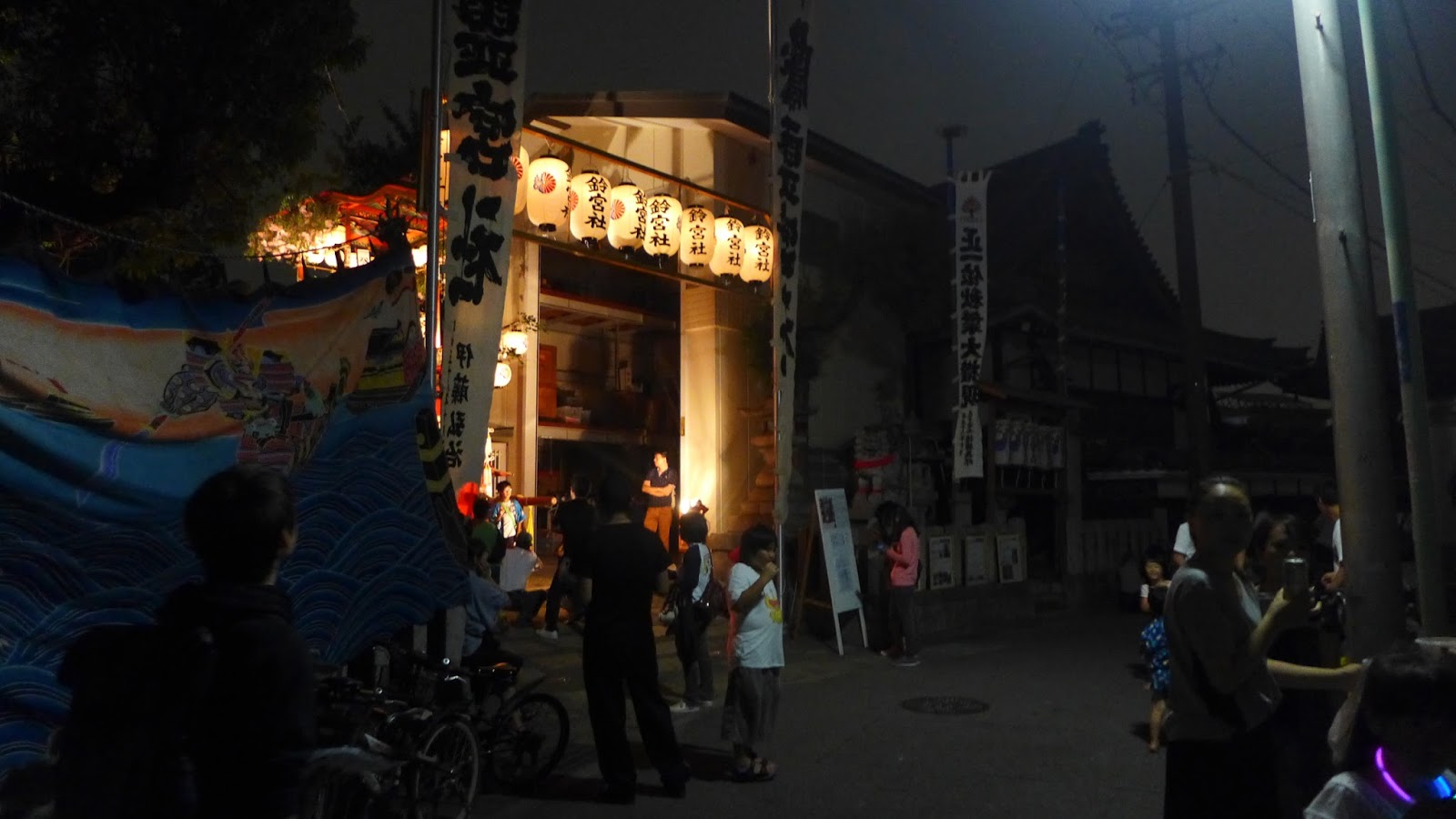
My guide this evening is a first year college student named Daiki. We search for the next karakuri ningyo performance at Tenjisha shrine as he tells me about his first semester in dental school. We walk through Toda's dark and narrow alleys with only the light from Google Maps and a few flickering Japanese lanterns. It's one of the first chilly nights of autumn, and traveling the streets, moving from shrine to shrine, it starts to feel a bit like Halloween."Have you seen Gilmore Girls?" I ask Daiki. He never heard of it- but he is a big Bruno Mars fan.  


We catch the glow of a dashi in the distance, give-up on Google Maps, and follow it.

Two rows of children sit behind kotsuzumi drums. The music teacher provides some last minute instructions as a dozen young boys line-up in front of the hanging taiko.


The drums pulse as the karakuri ningyo climbs across a set of monkey bars and hangs upside down from his knees. Like a magician rolling up his sleeves, the last bar rotates outward with the swinging puppet hovering above the ground, revealing the absence of strings or rods. The karakuri ningyo returns to his original position as the boys make their final blows on the large taiko drum.


At Zuyumia shrine, Daiki introduces me to dango, a sweet rice dumpling that is lightly seared over flames and covered in a Japanese molasses.


It's only 100 yen and the line is short, so I go back for seconds, promising Daiki I will floss after I get back to my apartment.


As the night falls, teenagers come out to enjoy the festival food, watch the performances, and snap photos. But, without the presence of tv crews and tourists, the festival never gets overwhelming. No one is worried about applying enough sunscreen, a crowded train ride home, or squeezing through people to get a better spot for the next performance. With the fall breeze and natural small-town coziness, there's something about Toda Matsuri that feels unexpectedly nostalgic.

But the festival never gets overwhelming. No one is worried about applying enough sunscreen, a crowded train ride home, or squeezing through people to get a better spot for the next performance. With the fall breeze and natural small-town coziness, there's something about Toda Matsuri that feels unexpectedly nostalgic.


A Chinese calligrapher stands at the top of the dashi at Zuyumia Shrine. Not an actual Chinese calligrapher, but a puppet Chinese calligrapher wearing a grin that suggests he knows exactly how impressed you're about to be.


He removes a pen and starts to write on a suspended piece of translucent paper. The audience can see the ink soak through the paper as lines take shape. If you watch carefully, you can even catch the subtle movement of the puppet's head following the pen's tip.

After the final stroke, the paper is revealed to the audience from the front. I'm not sure what it reads, but the penmanship is flawless. I have to remind myself that it was written by a puppet operated by a 17th century method of strings and wooden rods. 


The crowd of teenagers, children, and parents applaud as the puppeteer emerges. He wears a grin not unlike the puppet, as he removes the paper and holds it above his head.


The audience cheers as he tosses the paper into the air. It floats to a young woman, hands outstretched. She shows her friends, smiling contagiously, and then passes it to a young boy by her side.


"What did it say?" I ask Daiki.

"Akizora," he replies.

"What does that mean?"

"Autumn sky."