Zach Dorn is theatre-maker, puppeteer, and animator studying traditional puppetry and contemporary theater in Japan. He is currently a Julie Taymor World Theater Fellow. www.zachdorn.com.
On April 1st, Inuyama Matsuri marks the start of Japan's spring festival season. Over the course of a few months, hundreds of floats will emerge from their winter hibernation and travel across the small towns of Aichi Prefecture bringing music, excitement, and puppet shows.
Often known as Aichi's "Little Kyoto,” Inuyama is lined with preserved Edo era homes, traditional Japanese inns, tea houses, and museums. The small but popular destination welcomes visitors with Japan's oldest castle, which towers over Haritsuna Shrine, home base for Inuyama's spring festival. With its enormous parade of thirteen ornamental dashi, large crowds of excited visitors, and neighborhoods brimming with culture, Inuyama is the perfect place to fall back into Japan's festival season.
On the first day of the celebration, Inuyama's dashi, or yama, gather in front of Haritsuna Shrine. The thirteen floats, each adorned with karakuri ningyo, tower above thousands of eager spectators. These are some of the tallest dashi in the Japan, measuring about 7 meters high. However, they are more slender than their cousins, and, despite their height, weigh about the same. Instead of ornate wooden carvings, the dashi are constructed from narrow beams and adorned in local textiles. Also, To help manage the float's weight, the karakuri ningyo puppets are a bit smaller.
Inuyama Matsuri is home to one of Aichi's most unique floats, a stunning 6 meter boat that travels through the narrow streets performing the story of Urashima, an old man who spends four hundred years underneath the Pacific. Typically a dashi's decorations, carvings, and embroidery won't offer too many clues into the karakuri ningyo they shelter. However, this stunning gold-trimmed vessel creates a unified vision of Urashima's famous nautical tale.
Urashima is not the only celebrated personality at Inuyama Matsuri. While children always play an important role in Japanese festivals, from pulling floats to playing music, the kids in Inuyama are adorned like living idols. The leader of the annual festival, or chigo, is selected each year from local primary school students. This six year old is draped in silks and a crown as he leads the annual procession.
Other children are dressed in beautiful outfits accessorized with decorative swans.
Like the blossoming sakura that attracts millions of tourists to Japan from across the globe, children represent Spring's sense of purity, rebirth, and future prosperity.
However, this has not been a good year for cherry blossoms. While April 1st in Inuyama is usually marked by a vibrant backdrop of blooming flowers, an unusual shift in weather has brought a spring season lacking the renowned colorful flourishes. As the afternoon parade of children lead the dashi underneath the naked trees, my mentor and friend Yasuko Senda can't help but mention the number of kids participating seems to shrink each year.
For locals, the future of these festival traditions always feels precarious. During the opening ceremonies, Inuyama's mayor mentions another event happening simultaneously 30km away - the grand opening of Japan's first Legoland. Sure, it will contribute to the economic development and growth of tourism to Aichi Prefecture, but the mayor reminds the crowd that it's got nothing on his hometown's 383 year old festival.
Compared to performances of Bunraku and Noh, where the majority of audience members are elderly enthusiasts in their 70s and 80s, I feel like Japan's festivals are far from drifting into obscurity. I mean, I just had to scramble through a crowd 3,000 people to watch a puppet show. But the residents in small town Japan are more aware of the country's population decline and impact of locals migrating to urban centers. It's inescapable, no matter how busy the festivals get. The children, with swans rising from their backs and head pieces tangled into blinking LEDs, aren't just symbols, but physical treasures of hope and endurance.
Inuyama Matsuri continues for two days, marked by a stunning night parade and another performance of the thirteen karakuri ningyo.
The shows on the second day are performed at the shrine. Each dashi is pushed towards the torii gate by a team of young men.
Unlike other floats, the massive wheels allow men to gather underneath the dashi to push and pull the towering vehicles throughout the city.
The floats are are filled with the local children, who look down at the crowds with curiosity, as the puppets perform for the gods.
In the neighboring city of Ichinomiya, the small town hosts their own festival two weeks later. Given their close proximity, the two matsuri share a lot of similarities, particularly the slender and towering dashi. However, Ichinomiya's floats are more modest. Instead of expensive fabrics and ornate decorations, the dashi are decorated in white papers that symbolize donations received from community members.
Inuyama's city government allocates a large budget to preserve and promote the annual festival. However, Ichinomiya lacks government support. Instead, the festival relies on the local shrine, Iwato Jinja, to organize fundraising efforts. While the festival might feel a bit more unorganized, lacking the Master of Ceremonies and VIP tents for special guests, the event is filled with ritual, including the offering of seven well-dressed horses to the shrine's god before they are paraded through the town's streets.
While the dashi may not have the same ornamental flare or financial support as Inuyama, the karakuri ningyo in Ichinomiya are well-rehearsed and exciting. It's some of the best performances I've seen so far during the spring season.
While watching the mechanical puppets trapeze across the towering stage, it corroborates my new adage, "You can't judge a puppet by it's dashi."
As I head to Kyoto Station from Otsu Matsuri, I have a deep suspicion I'm not going to make it to Takayama Matsuri. I’m certain I'm on the wrong platform, even as I watch the corresponding trains pull into the station. On the bus from Nagoya to Takayama, I convince myself I missed my stop and I'm actually headed to Hokkaido's most northern tip. What if I lose my wallet? Or the train never shows up? This anxiety was anticipated. I am headed to one of Japan's most legendary karakuri ningyo shows, and it's only performed on one day of the year. If I miss this - that's it. But I'm in Japan - where wallets are usually returned and a late train is a mythical legend. Of course, I arrive in Takayama right on time.
As I make my way through the thousands of tourists to my ryokan near Hachiman shrine, the city puts me at ease. Despite the crowds, Takayama's beauty and charm is intoxicating. The city feels wonderfully timeless, combining Edo Period architecture with sprawling glass storefronts that reveal ultra-modern wooden furniture and stainless steel home goods. Glossy Post-War diners with Art Deco signage share the streets with 16th century sake breweries. Despite Takayama's blend of contemporary style and historic buildings, nothing feels out of place. If anything, Takayama reveals the ageless aesthetic of Japan's minimalism and its influence on modern design. As night falls, the dashi, or yatai as they are called in Takayama, parade down Yasukowa Street. A coalition of fantastical lions leads the dazzling cavalcade. The mouths swing open and snap with electrifying cracks that complement their wiry hair and devious grins.
The lions' heads and bodies are manipulated by teams of teenage boys, who balance wild energy with perfect harmony. Despite the frenetic energy, the puppeteers are possessively committed.
Unlike other festivals, where teenage participants are celebratory and carefree, these young puppeteers are focused. In their dedication, you can see their fathers, grandfathers, and great-grandfathers who once performed the same custom. They don't just carry the the paulownia carved lion masks, but the weight of Takayama's history.
The eleven yatai stretch across the main street and greet visitors with magnificent grandeur.
The ohayashi and kajikata gather around the floats to prepare for the evening procession, as awe struck tourists travel from yatai to yatai.
The illuminated floats are hypnotizing. The amount of resources needed to create this timeless wonder is staggering, and set against an international crowd of over 100,000 open-mouthed onlookers, it feels like a World's Fair.
It's the the pursuit of aesthetic pleasures against the logic of an economist. But it pays off. As the floats journey into Takayama's historic neighborhoods, their beauty grows even more enchanting.
The boroughs of Takayama are magnificently preserved in Edo architecture. Exposed running water straddles the streets, vending machines are obsolete, and hundreds of paper street lamps illuminate the road by flame. You are experiencing the town and festival almost the same way a visitor would have 350 years earlier.
The next morning, on my way to the fall festival's karakuri ningyo performance, I am met with Takayama Matsuri's procession, or keitoraku. In the procession I discover the generations of lion performers.
Takayama's karakuri ningyo performance is over 350 years old. It's performed only one day a year, during this Hachiman Festival. It's also one of Japan's longest karakuri ningyo performances, running about 25 minutes. Like the puppets at Otsu Matsuri, Takayama's karakuri ningyo are operated by strings that run across a narrow overhanging stage, or toi. However, with over three dozen strings and more intricate movement, the manipulation is even more demanding. Because they're primarily operated by strings, Takayama's mechanical dolls are often translated to marionette, but in Japanese they are called karako. There's an air of secrecy in the rehearsal and set-up process.
A large embroidery shrouds the yatai's bottom tier and the response to foreigners trying to get an inside look is tepid to say the least. However, a few young boys come and go with the privileges of VIP. These are the future puppeteers, who drink juice boxes, and hang their feet over the edge of the yatai admiring the large audience.
The yatai is docked at Hachiman Shrine, and two hours before the performance, there are already at least three hundred spectators crowded around the 3 story float. I am lucky to receive a seat at the very front of the performance. Despite the enormous audience, people are careful not to stand in front of the sight lines of others. At one dramatic turn of events, the entire audience grows silent as a gentleman walks in front of the crowd and sets up a tripod. A few members start to shout. They've waited an entire year for this performance, they booked their ryokan months in advance, and they arrived three hours early to get a good seat. An irate audience member tosses his tripod, another man shouts, and eventually the photographer is escorted away from the scene by a friendly police officer. It's the first time I've ever witnessed a fight for seats at a puppet show.
The performance is packed full of miniature stunts that culminate in a grand feat of pure puppet glory. The god of good luck, Hotei, greets the crowd from the toi. An acrobat flips his way across a trapeze, and then hops onto the shoulders of the gregarious deity. Another acrobat follows behind. At the end of the show, Hotei dances around the track with the two acrobats on his shoulders. Once you think things couldn't get much more wild, Hotei spins in circles, opens a fan, and releases confetti to the crowd below.
I stick around Takayama for a few more days to explore the city's karakuri ningyo museum. The gallery offers daily karakuri ningyo performances. There is an over-sized calligrapher puppet, two robotic dolls that sword fight while balancing on columns, and an acrobat who swings across the stage.
But like a "best of album", these shows lack a certain magic. When watching a traditional festival performance, you're in a rambunctious dialogue with history, the city, and performers. Like the young lions dancing through Takayama's historic downtown, context makes these experiences more wondrous.
Is there anything in The United States that comes close to the rich interplay between community, history, and performance? Often, American parades and festivals feel like they run on borrowed time. The institutions remain in control, instead of allowing the festival to roam freely. This prevents festivals from creating a type of celebratory other-worldly escape. In the U.S., a city festival usually means your town’s most notorious realtor is waving from a pick-up truck while a few puppets parade around the local library. But we can’t help it - for the most part, we lack a historical context for festival performance.
There are a few exceptions - Mardi Gras for example.
Perhaps the most notable exception is Bread and Puppet, which I thought of frequently while attending Japanese Matsuri. Like Japan’s festival tradition, Bread and Puppet obscures the lines between community and performance.
(from http://breadandpuppet.org/)
(Tahara Matsuri, Aichi Prefecture, Japan. 2016)
Many of the puppeteers live on the Vermont farm, performing communal duties and engaging in a strict rehearsal regime. Like the matsuri communities, the Bread and Puppet farm and theatrical spectacles work in tandem. The shows feel as organic as the Vermont forest that surrounds you. Bread and Puppet has also been around long enough to draw from a substantial history. The theater group developed its own unique language of iconic characters and physical gesture. It keeps aesthetic guidelines and holds on to its historic traditions while remaining political. This makes it feel timeless, and, like the Japanese matsuri, ritualistic.
(from http://breadandpuppet.org/)
Back in Takayama, I watch as the floats are loaded back into garages throughout the city, and look for a spot to grab a cup of coffee. Many of the restaurants and souvenir shops are closed and have taken a well-deserved holiday. Even though the streets are empty, its the kind of place you don’t want to leave.
Like the yatai hibernating in their garages, I feel like sticking around till Takayama’s spring matsuri but instead, I’ll just have to take another train. Chances are high I’ll get back on time.
A group of elementary school students endlessly air-drum beneath the festival's dashi. They don't want to miss a note during tonight's performance. At Toda Matsuri, most of the musicians are children who have spent the last month of music class in preparation.
The audience is made-up of parents, proudly poised with digital cameras, and younger siblings who run freely through the shrine while grasping cotton candy. Sure - it's not a large crowd, but there's something so pleasant and comfortable about the small-town atmosphere in Toda that I catch myself singing The Gilmore Girls' theme songaloud to no one in particular.
I spend the afternoon at Hachiman shrine with a festival organizer, Mr. Yamada. Even at seventy three, Mr. Yamada climbs through the three-floor dashi with ease.
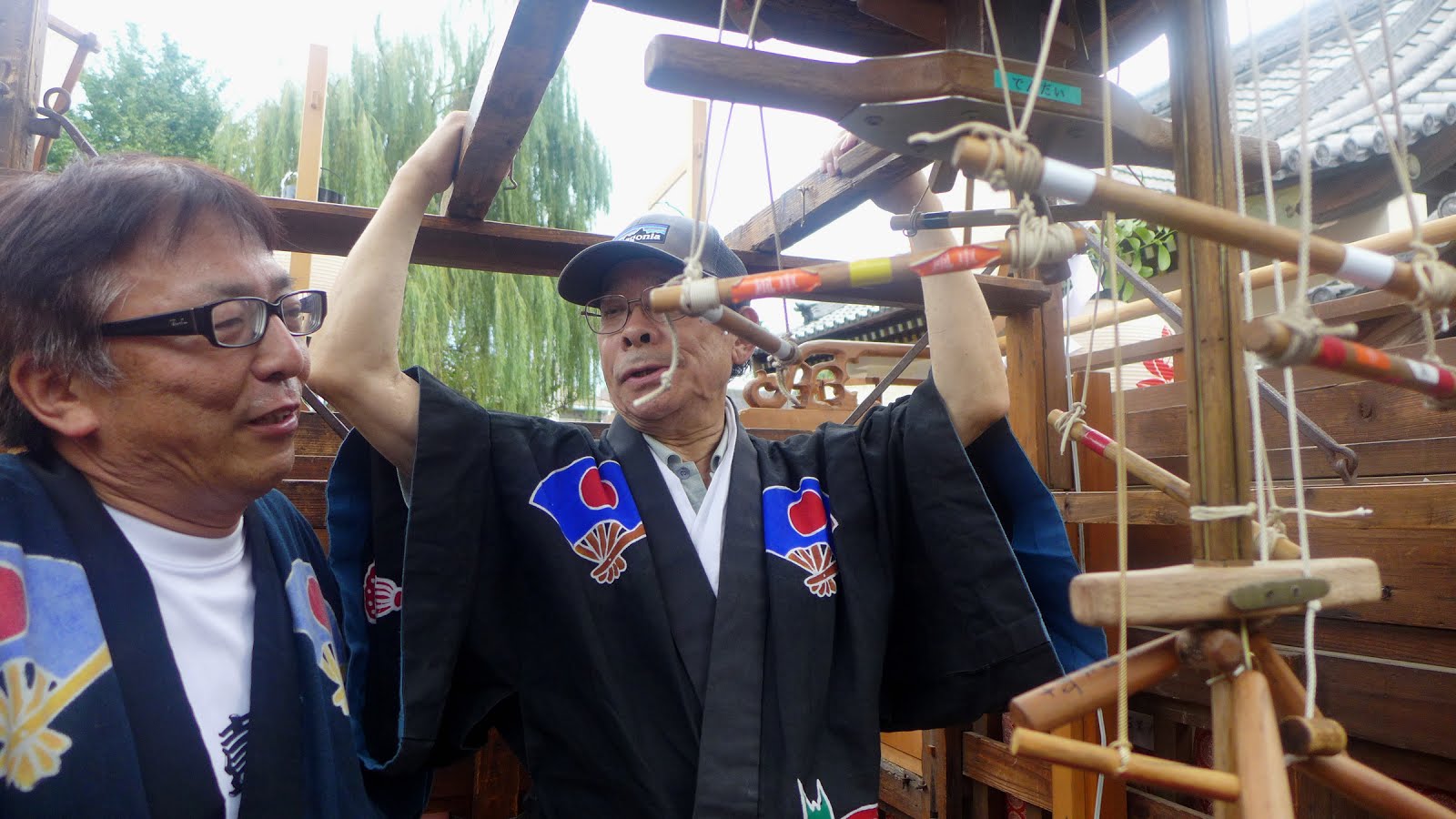
He is excited to speak English, share the shrine's history, and show off his fresh surgical scar from kidney surgery. Asahi beer cans, plastic containers of curry, and cigarettes line the edge of the 18th century dashi, as I climb on board and head to the second floor. The puppeteers are easy-going, but the karakuri ningyo is anything but simple. The puppet’s controls are a mix of strings, handle bars, and the sashigane technique I observed in Yokosuka.
To make things manageable, the puppeteers place brightly colored labels on each handle, and wear battery-operated headlamps during the performance.
Mr. Yamada explains that the puppets suspended above our heads are milling rice. The two robotic farmers rotate the mill with hand cranks, while a miniature acrobat stands on top. After a full rotation, a stage extends from the center of the mill and the puppet leaps into an impressive hand-stand. To Mr. Yamada, this performance captures the essence of Toda. "Rice Milling is Toda's main manufacturing," he says, staring upwards at the wooden puppet.
A 24-hour automat for uncooked white rice sits outside the shrine and one the most popular fair food this evening is dango (sweet rice dumplings). Rice is Toda's livelihood, and these three mechanical dolls give thanks to the gods who have granted it.
Toda's dashi is not as ornate as those in Yokosuka and Tahara, but they are some of of the oldest I've seen, dating back to 1702. A school teacher announces the performance on a portable karaoke machine, as the students gather into a shapeless circle, shyly hiding from the gaze of their families' cameras. Two grandfathers sit on the edge of the chozuya, or shrine fountain, smoking cigarettes and watching the puppeteer make final adjustments to the karakuri ningyo.
Despite the casualness of the festival, the performance is excellent. The manipulation is smooth and well-rehearsed. And even though the ohayashi is a group of elementary and middle school students, their music reflects the puppets' movements well and creates a unified spectacle.
The kids don't want the show to end. As the audience applauds, they gather around the float with their instruments and continue to play. The puppets join in, waving their arms, milling rice, and nodding their heads to the music below.
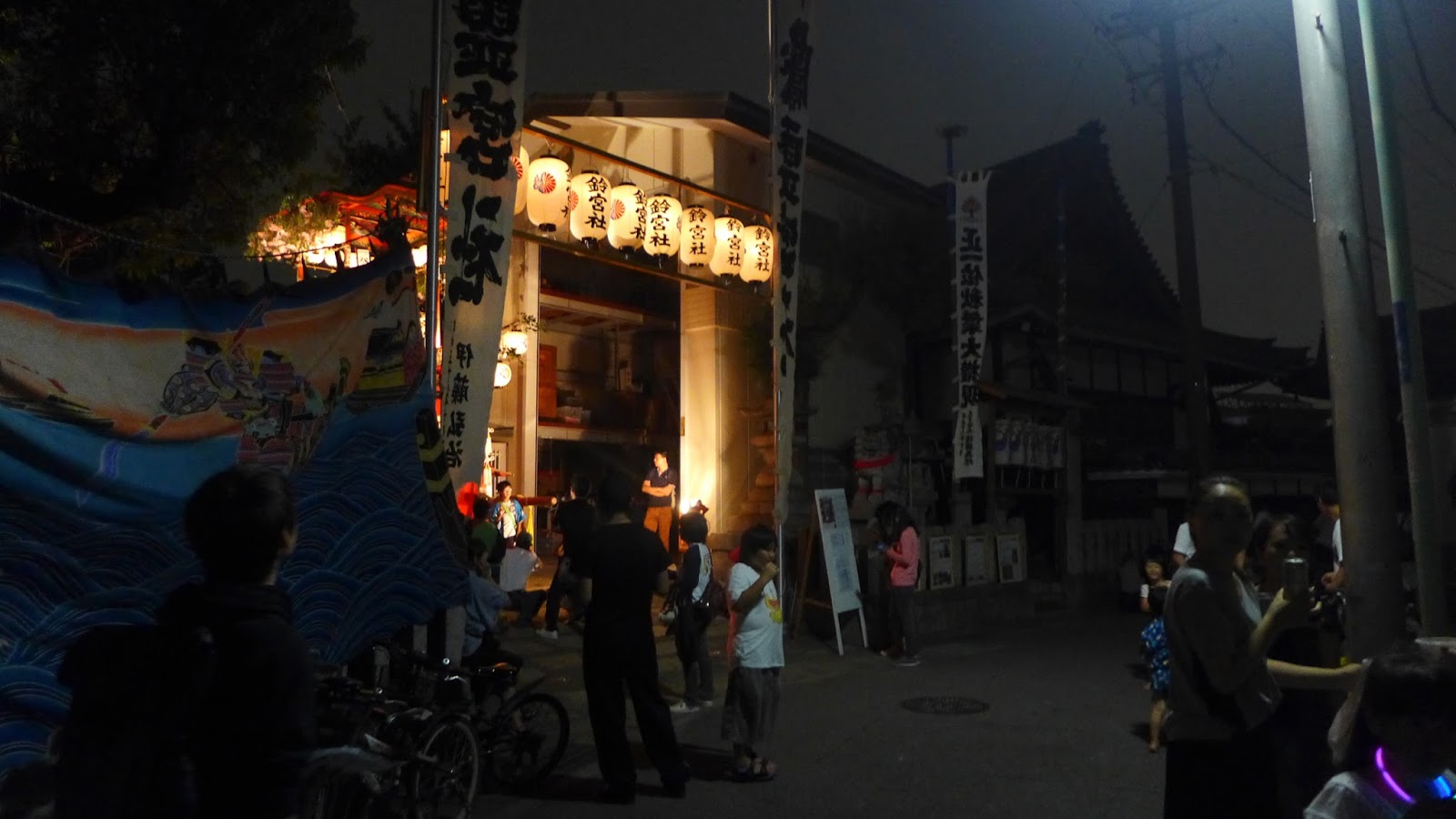
My guide this evening is a first year college student named Daiki. We search for the next karakuri ningyo performance at Tenjisha shrine as he tells me about his first semester in dental school. We walk through Toda's dark and narrow alleys with only the light from Google Maps and a few flickering Japanese lanterns. It's one of the first chilly nights of autumn, and traveling the streets, moving from shrine to shrine, it starts to feel a bit like Halloween."Have you seen Gilmore Girls?" I ask Daiki. He never heard of it- but he is a big Bruno Mars fan.
We catch the glow of a dashi in the distance, give-up on Google Maps, and follow it. Two rows of children sit behind kotsuzumi drums. The music teacher provides some last minute instructions as a dozen young boys line-up in front of the hanging taiko.
The drums pulse as the karakuri ningyo climbs across a set of monkey bars and hangs upside down from his knees. Like a magician rolling up his sleeves, the last bar rotates outward with the swinging puppet hovering above the ground, revealing the absence of strings or rods. The karakuri ningyo returns to his original position as the boys make their final blows on the large taiko drum.
At Zuyumia shrine, Daiki introduces me to dango, a sweet rice dumpling that is lightly seared over flames and covered in a Japanese molasses.
It's only 100 yen and the line is short, so I go back for seconds, promising Daiki I will floss after I get back to my apartment.
As the night falls, teenagers come out to enjoy the festival food, watch the performances, and snap photos.But, without the presence of tv crews and tourists, the festival never gets overwhelming. No one is worried about applying enough sunscreen, a crowded train ride home, or squeezing through people to get a better spot for the next performance. With the fall breeze and natural small-town coziness, there's something about Toda Matsuri that feels unexpectedly nostalgic. But the festival never gets overwhelming. No one is worried about applying enough sunscreen, a crowded train ride home, or squeezing through people to get a better spot for the next performance. With the fall breeze and natural small-town coziness, there's something about Toda Matsuri that feels unexpectedly nostalgic.
A Chinese calligrapher stands at the top of the dashi at Zuyumia Shrine. Not an actual Chinese calligrapher, but a puppet Chinese calligrapher wearing a grin that suggests he knows exactly how impressed you're about to be.
He removes a pen and starts to write on a suspended piece of translucent paper. The audience can see the ink soak through the paper as lines take shape. If you watch carefully, you can even catch the subtle movement of the puppet's head following the pen's tip.
After the final stroke, the paper is revealed to the audience from the front. I'm not sure what it reads, but the penmanship is flawless. I have to remind myself that it was written by a puppet operated by a 17th century method of strings and wooden rods.
The crowd of teenagers, children, and parents applaud as the puppeteer emerges. He wears a grin not unlike the puppet, as he removes the paper and holds it above his head.
The audience cheers as he tosses the paper into the air. It floats to a young woman, hands outstretched. She shows her friends, smiling contagiously, and then passes it to a young boy by her side.